Published:
Can a Single Philosophy Change in Your Code Increase Performance by 100 Times?
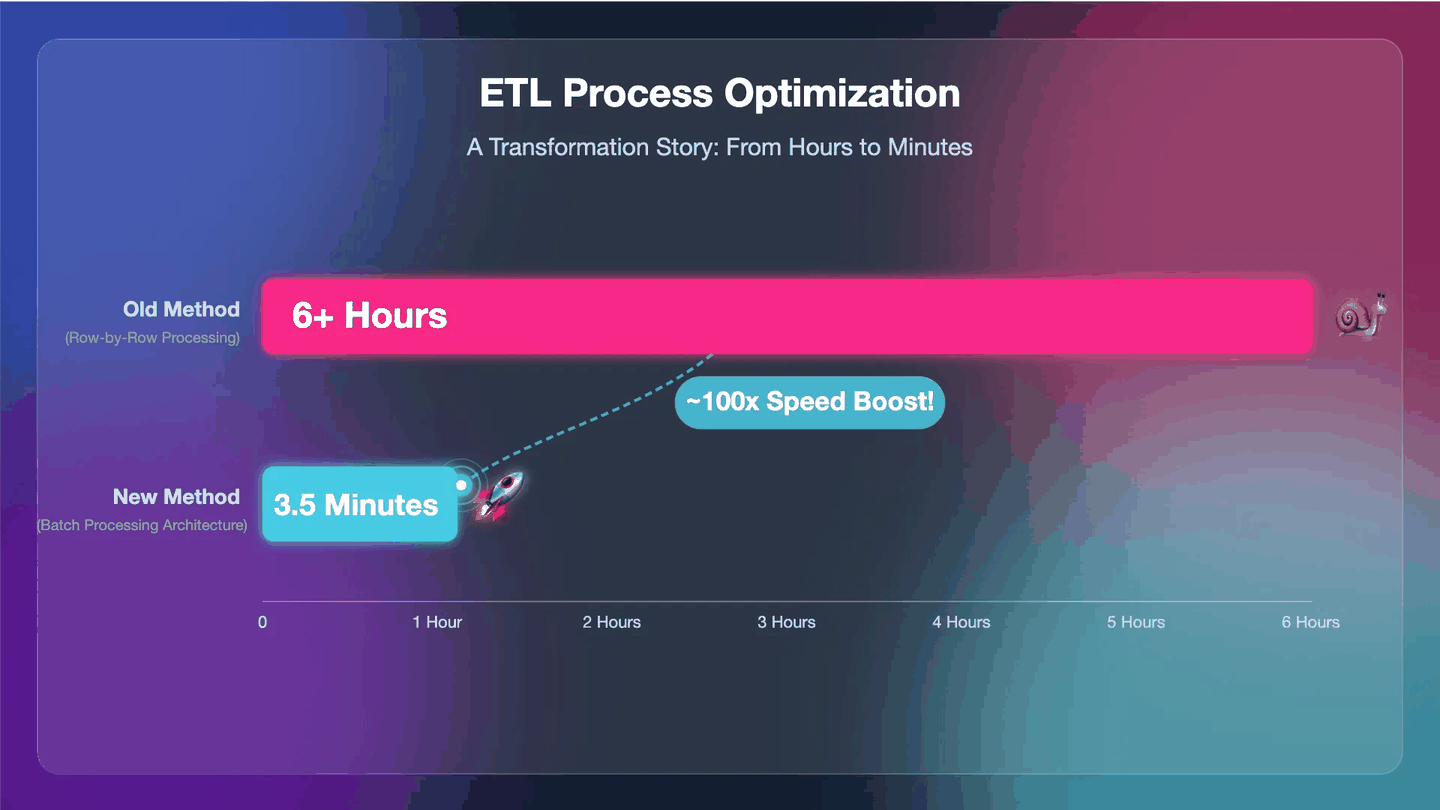
A multi-hour ETL job dropped to 3.5 minutes after one shift in approach - from row-by-row thinking to set-based thinking. Here's the story of a 100x speedup.
Hours-long ETL jobs. Databases that keep choking. Waits with no clear end in sight... Sound familiar?
We ran into exactly this not long ago, in a job that was taking over 6 hours.
The Problem: That Infamous "Query-in-a-Loop" Anti-Pattern
The original code had a structure that looked innocent in theory but was a performance killer in practice. To process millions of rows, it did this:
- Pull the data from the main table with a CURSOR.
- Start a LOOP.
- Inside the loop, for that one single row, fire SELECT queries at other tables, over and over, to look up extra information.
- Still inside the loop, INSERT that single row into the target table.
- Move to the next row and repeat step 3 millions of times.
Where's the problem? Millions of rows means millions of round trips between the PL/SQL engine and the SQL engine. This creates a brutal cost known as a "context switch," and it eats system resources alive.
Now, what if I told you the fix wasn't to untangle that complicated loop - but to change our entire approach to the code?
That was our "Aha!" moment, the one thing that changed everything. And that single philosophy change was this:
Stop thinking row by row. Start thinking in sets.
In other words: instead of acting like a micromanager who hands the database one command at a time, act like a strategist who states what they want and lets the database figure out how.
When we translated this philosophy into code, the results were hard to believe. The 6+ hour job finished in 3.5 minutes. A speedup of over 100 times.
So How, Exactly? Here's What We Changed
- One query, one job: We threw out the dozens of SELECT queries buried inside the loop. All the data-gathering and enrichment logic went into a single, smart CURSOR built with WITH and OUTER APPLY.
- Bulk fetching (BULK COLLECT): Instead of pulling data row by row, we loaded it into memory in batches of 100,000, minimizing I/O.
- Bulk writing (FORALL): We wrote each batch of 100,000 records to the target table in a single operation using FORALL. That took our conversation count with the database from a million down to one.
- Parallel power: PARALLEL hints told the database to use all the hardware muscle it had for the job.
- Solid coding practices: Modern PL/SQL constructs like CURSOR%ROWTYPE, INDICES OF and CONSTANT made the code both more resilient to future changes and easier to maintain.
Here's what that philosophy looks like in code:
DECLARE
    -- 1. All the logic lives in one CURSOR that thinks in sets.
    CURSOR c_records IS
    WITH ...
    SELECT
        /*+ PARALLEL(16) */ ...
    FROM
        Source_Table ST ...;

    -- 2. Data is held in a collection, in batches.
    TYPE t_record_list IS TABLE OF c_records%ROWTYPE;
    v_RECORDS t_record_list;
    c_BATCH_SIZE CONSTANT PLS_INTEGER := 100000;
BEGIN
    OPEN c_records;
    LOOP
        -- 3. Data is fetched in bulk.
        FETCH c_records BULK COLLECT INTO v_RECORDS LIMIT c_BATCH_SIZE;
        EXIT WHEN v_RECORDS.Count = 0;

        -- 4. Data is written in bulk.
        FORALL i IN INDICES OF v_RECORDS
            INSERT /*+ APPEND PARALLEL(8) */ INTO Target_Table VALUES v_RECORDS(i);

        COMMIT;
    END LOOP;
    CLOSE c_records;
END;
In the end, we learned that the biggest performance win wasn't hiding in the most complex algorithm - it was in the most fundamental change of approach.
This article was originally published on Medium.